Nine months on the phone, in the order it went
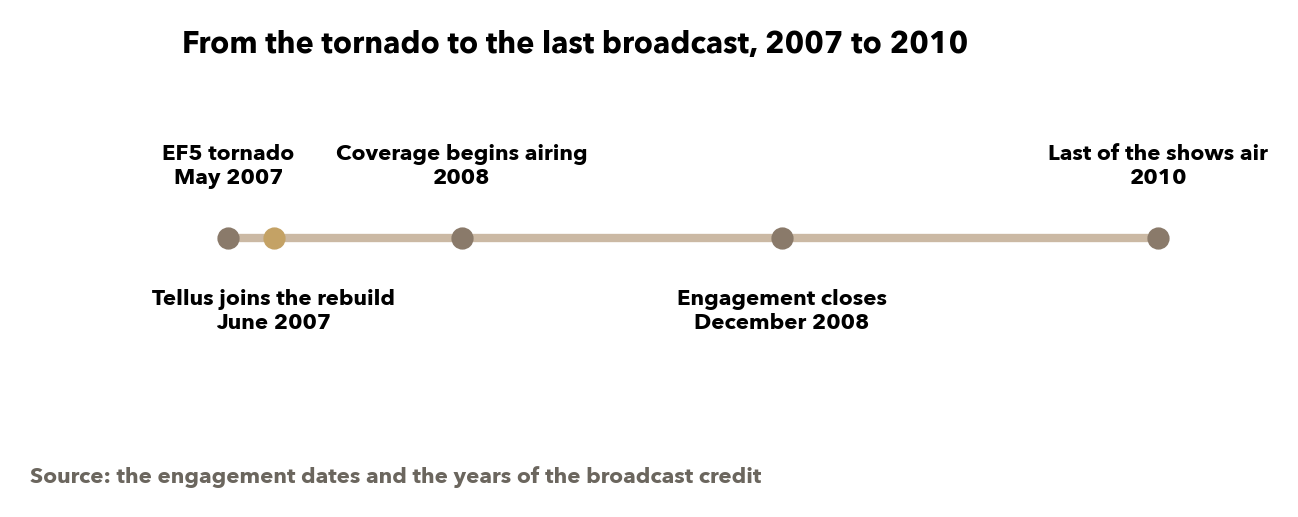
- Confirm the asset before the first call. Known: Discovery Channel had contracted Tellus and was committed to filming. Unknown: how long, how many shows, and which stages the crews would be on site for. The question I asked the production side first was what they would actually film and when, because a sponsor buys stages, not a promise of coverage. It produced the filmed-stage list that the slot map is built on, and it meant every call I made afterward opened with a broadcaster's commitment rather than a town's need.
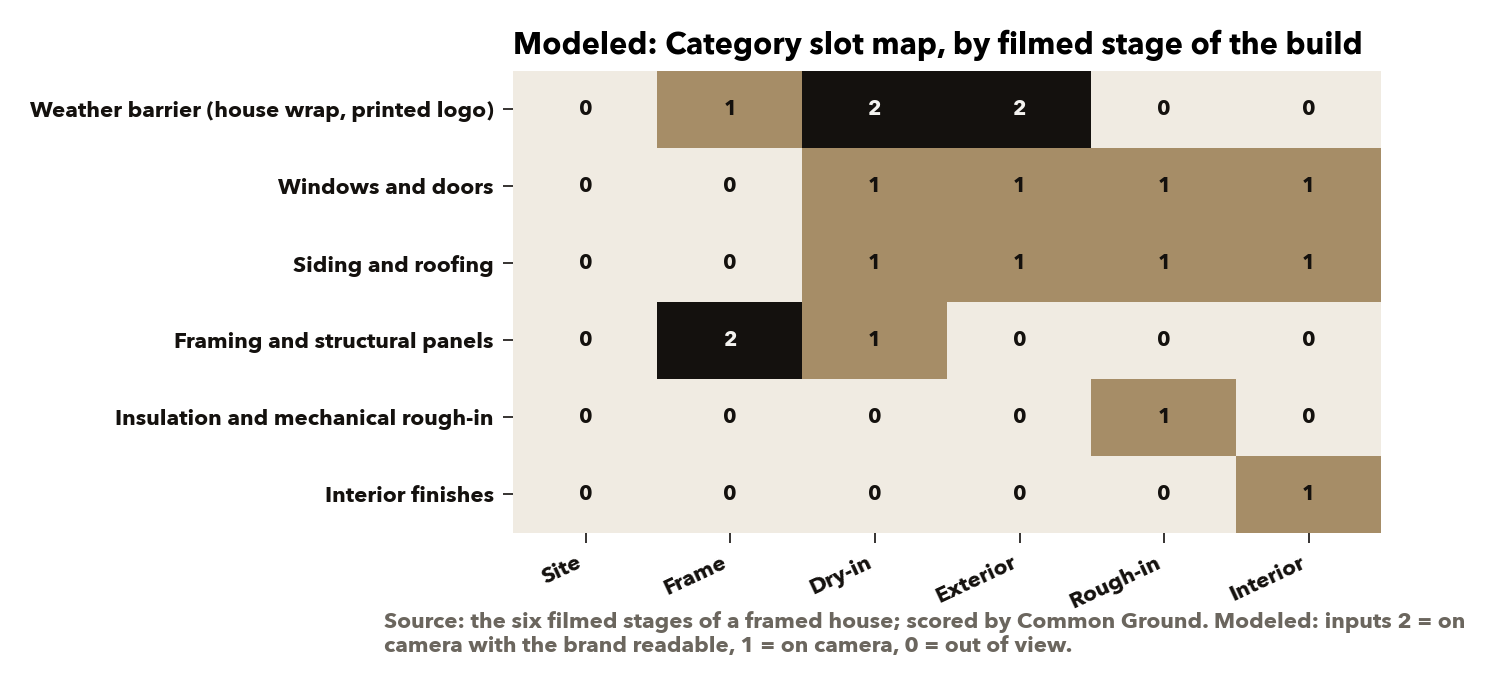
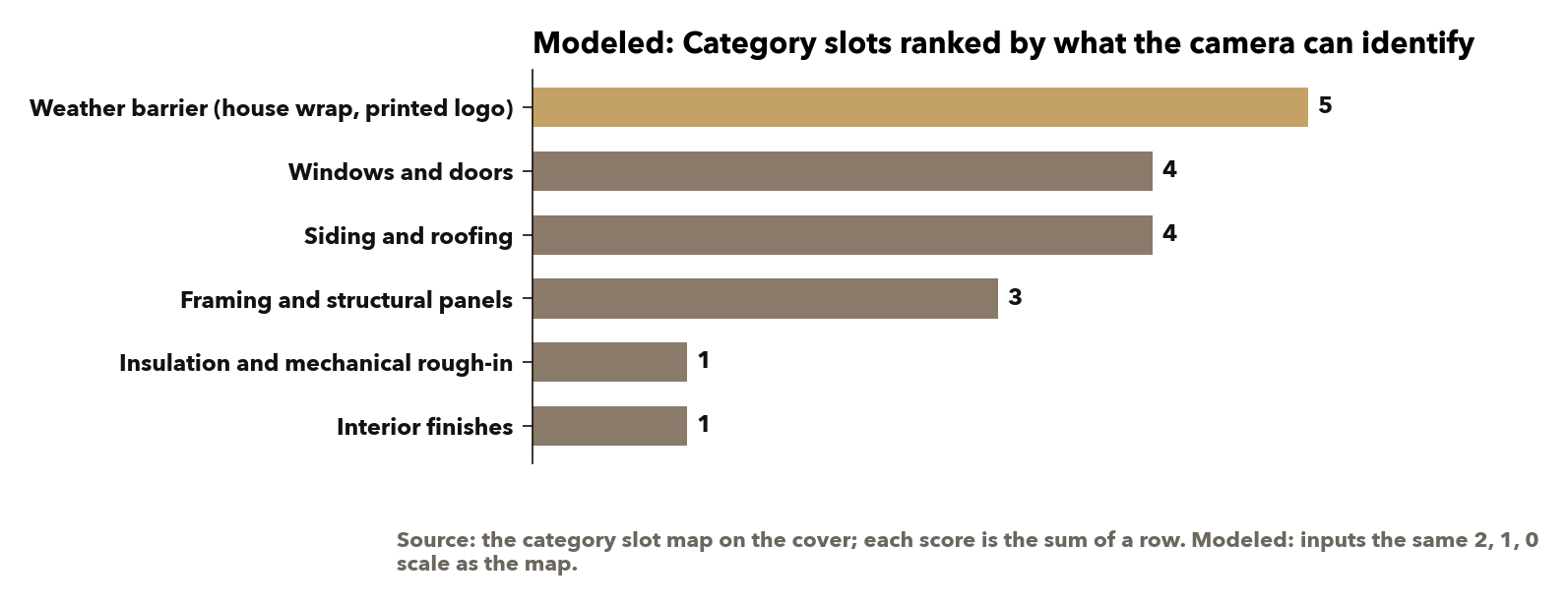
- Build the slot list. Known: the material schedule of a high-performance house. The question was which categories a viewer could identify on film and for how long. That is the map below. It changed the target list: the products the town most needed were not the first calls, and the products a brand most wanted to be seen in were.
- Find the buyer inside the company. Known: every manufacturer had a philanthropy contact, and none of them could fund this. The question on each first call was who owned the brand or category marketing budget and what that person was already paid to deliver. Reaching that person was most of the calling. A cold call that lands on the wrong desk gets a polite letter back; the same call on the right desk gets a meeting, because the marketing lead recognizes a flagship story when one is offered.
- Anchor. Known: an exclusivity structure with no sponsor in it is a proposal. The question was which category could be closed first and would be visible enough to make the structure real for everyone after. DuPont's commitment did that. From then on every pitch had a live example instead of a diagram.
- Fill the categories. Known: DuPont's slot, and a map with the rest open. Building-supply companies and a tire and rubber manufacturer came in behind DuPont, each into its own category, each exclusive there. I made the calls myself rather than through an agency, because the story had to come from someone who had stood on the site, and I did not walk away from any manufacturer who wanted in. That last choice had a cost, and the next step is where it landed.
- Make what arrived work inside one design. Known: the redesign had one green standard across the homes and the commercial buildings, and the donated products were a hodgepodge, arriving from different manufacturers on their own schedules and in their own specifications. The question for my preconstruction team on every delivery was whether the product met the performance the design required and what it cost in detailing to make it fit the assembly it was joining. We made it work within the design rather than send anything back. We ran that check by hand, delivery by delivery; Attachment B writes it down as the gate I would hand another builder.
- Deliver the credit. Known: a sponsor who is not seen on camera did not get what it paid for. The last job was coordination with the production schedule so that each manufacturer's product was on site, installed and visible at the stage the crews filmed it. That is a construction scheduling task in service of a marketing promise, and it is the part a builder is uniquely placed to keep.
| Stage | The question at the gate | What got a manufacturer through it |
|---|---|---|
| The asset | Is the broadcaster committed, and to which filmed stages | A production commitment I could describe on a call |
| The slot | Can a viewer identify this product on film, at any stage | A place on the map above the enclosed categories |
| The buyer | Who inside the company owns the marketing line, and what are they paid to deliver | A brand or category marketing lead on the phone, not a philanthropy contact |
| The offer | One manufacturer in this category, exclusive, on camera | Verbal interest from the marketing lead |
| The commitment | Will the product ship, in the quantity and to the schedule the build needs | A shipment commitment against the construction schedule |
| The fit | Does it meet the design's performance, and what does it cost to detail in | Passed the fit check in Attachment B |
| The credit | Was it on camera at the stage the crews filmed | The sponsor visible in the coverage |
What reached the site
The result on the cover is the one figure a reader could check. It reached every home and commercial building in the redesign as donated product, not as cash, at wholesale value, from a program that began with no purchasing budget at all. Discovery Channel and Planet Green covered the rebuild, an episode of Build It Bigger with Danny Forster among the shows, with three others that launched with the build.
What the program covered, and what the camera filmed there:
| Structures | What the donated materials went into | What the crews filmed |
|---|---|---|
| The homes | The envelope, the framing and structural panels, the insulation and mechanical systems, the finishes, to one high-performance standard | Framing through the reveal, which is where a house is most filmable and where the anchor product was most visible |
| The commercial buildings | The same categories at commercial scale, inside the town's green redesign | The public rebuild the town had chosen, which is the story the broadcaster came for |
I have called this the best business development work of my career, and I still think so. It was never a donation ask. It was a sale, made to people who had a budget for exactly what I was offering and had not known they wanted it until someone described it as a slot. A disaster rebuild is a sales job before it is a construction job, and the negotiation nobody sees matters more than the framing everyone photographs.
The standard we kept, the appeal we replaced
We kept the town's standard. The green redesign was the town's decision and my job was to hold it while the materials arrived from every direction; nothing in the sponsorship program was allowed to lower the specification, which is why every delivery got checked. We also kept the broadcaster's production schedule as the fixed clock, since a sponsor's credit depended on it.
We replaced the donation appeal. The town's rebuild program had put it in, and any town would have, because the appeal assumes the recipient's compassion is the deciding variable. The fault in that logic is that compassion sits at a desk with a small budget; the appeal was never going to fail for lack of sympathy, it was going to fail for lack of a budget line big enough to say yes. It had to change in the summer of 2007 rather than later because the specification was fixed and the cameras had a date. There was no version of waiting for a budget that arrived in time.
The category-slot rule
- Confirm the distribution asset exists and which stages it covers, before the first call.
- List the product categories the build needs. Score each one by whether a viewer can identify the product on camera, and at how many filmed stages, with a readable brand scoring above a visible one.
- Sell each category once, exclusive, to the brand or category marketing lead, never to the philanthropy desk.
- Close the most identifiable category first, so every later pitch has a live example.
- Deliver the credit on the construction schedule, or the sponsor did not get what it bought.
The logic that had to change: the town ranked materials by what they cost, which is the town's variable. A sponsor pays for scarcity and for being seen, which is the camera's variable. Attachment A is the method in full.
The second thing we installed was the fit check on donated products, the question my preconstruction team put to every delivery that differed from the drawings. It existed because I chose not to turn any manufacturer away, and a program that accepts everything needs a disciplined way to fit everything. I have used the same sell-the-slot logic since, in a golf sponsorship program with nothing in common with a house, and it held.
What it cost to take everyone, and what I would watch
The calls took months of a builder's time while the builder also had preconstruction and construction teams to run, and most of that time was spent reaching the right desk rather than persuading it. Taking every manufacturer who wanted in meant the design absorbed a hodgepodge, and absorbing it was paid for in detailing, in coordination and in a preconstruction team that had to re-check assemblies it would normally have specified once. Selling exclusivity meant a category was closed the moment it sold, so a better product that called later had nowhere to go. And a sale that promises a camera is only as good as the schedule that puts the product in front of it, which turned every delivery date into a marketing obligation.
What I watched for, to know I was wrong, was silence after the second or third call, no movement at all. It did not come. I would make every one of those trades again on the same facts. What I would watch, on any program that sells a distribution asset instead of asking for help:
- The asset before the ask. If the broadcaster, the channel or the platform is not committed, there is nothing to sell and the call is a donation appeal with better vocabulary.
- The right desk. Most of the time goes into finding the person whose budget exists to buy this. Do not let a warm reply from the wrong desk feel like progress.
- Identifiability over cost. Rank by what the viewer can tell, not by what the town needs most. The needed categories get filled last, by the credibility the visible ones built.
- One per category, kept. Exclusivity is the product. Selling it twice ends the program.
- The design holds. Take what arrives, but only through a check; the specification is the one thing a sponsor cannot be allowed to buy down.
- Credit on the clock. The sponsor was promised a stage. The construction schedule is now a marketing schedule as well, and a builder is the only one in the room who can keep both.
What it produced
More than $30 million of donated sustainable materials, at wholesale value, reached thirteen rebuilt homes and the commercial buildings, from a program that began with no purchasing budget at all.
A slice of the project list
A few related projects.
- Habitat for Humanity: material, bid work, labor and consulting donated to nonprofit housing chapters (2007 to 2016)
- Soft-story retrofits: a financed seismic compliance service line at Tellus (2017)
- Santa Monica House: a custom home finished through a 2020 crew shortage (2020)